For many women, losing themselves in a relationship happens slowly, almost without notice, through small changes that don’t seem like a big deal at first.
You start by making room for someone else and letting go of your own preferences. You may also ignore small things and explain yourself more than you need to just to keep the peace.
Each action alone doesn’t feel like giving up on yourself. But over time, all these small choices can leave you feeling unsure, unsteady, and disconnected from who you are.
It is something many of us are taught by society. From a young age, girls are often praised for being agreeable, understanding, and easy to be around.
They are told they are mature, patient, and empathetic. These are good qualities, but over time, they can turn into expectations.
Emotional work and flexibility become the norm, and keeping others comfortable feels expected.
Many women are not shown how to stay true to themselves while loving someone else.
In adult relationships, this upbringing often leads to anticipating others’ needs, taking on frustration for peace, and fixing problems after arguments, even when not at fault.
Sometimes, this feels like love, and sometimes it is. But if it always falls on you, it becomes a pattern where the relationship overshadows you.
Part of the challenge is that intensity is often confused with real closeness. Big emotions, quick connections, and always being in touch can seem deep.
But intensity is not the same as feeling safe. If you often feel on edge, waiting for a text, reading into someone’s words, or worrying about your place, it might not be closeness you feel. It could be anxiety.
Learning to distinguish between steady love and unpredictable feelings is an important skill for healthy relationships.
There is also a common fear of being seen as “too much.” Many women hold back from sharing their discomfort because they do not want to seem demanding or dramatic.
Instead of saying, “This doesn’t work for me,” they might say, “It’s probably nothing.”
Instead of asking for what they need, they tell themselves to just wait, letting the urge to keep things peaceful outweigh their need to stay true to themselves.
Over time, self-trust fades as she has learns to doubt herself. Loving without losing yourself requires tolerating a different kind of discomfort, such as:-
- Disappointing someone.
- Risking misunderstanding.
- Accepting that someone who prefers a smaller version of you is not aligned with the real one.
That shift can feel destabilizing, especially when relationship maintenance has long been treated as the measure of success.
Real change is about staying connected to your feelings while caring for someone else.
When you start to put yourself at the center, things often become less confusing. You see patterns more clearly, and your choices feel more intentional.
You cannot control how others react, but you can decide how much of yourself you are willing to give for the sake of connection.
Loving without losing yourself is hard when you’re taught that the relationship matters more than autonomy.
Reversing that hierarchy takes awareness and the right language. And it takes the willingness to stay anchored even when the pull to adjust feels strong.
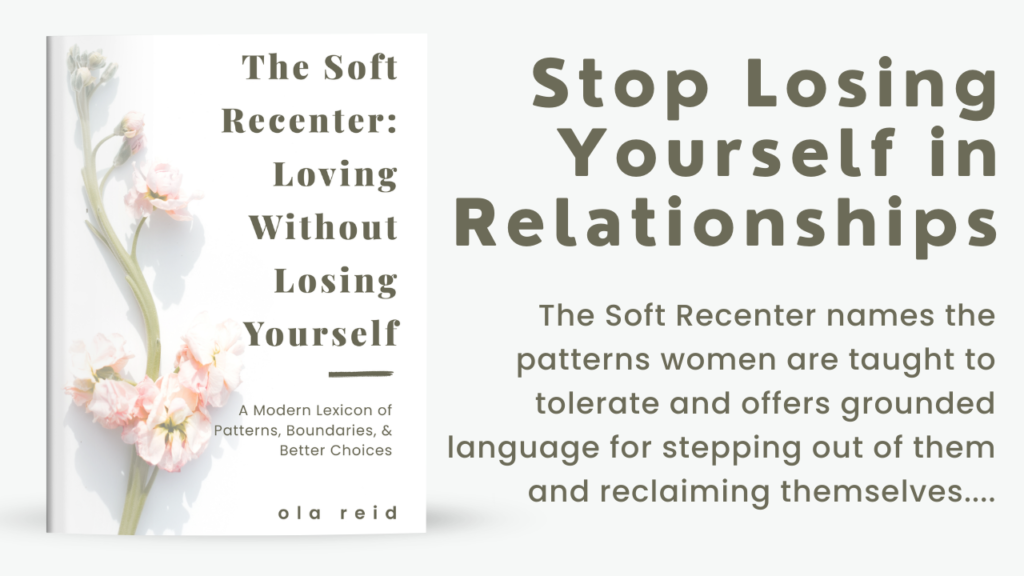
If this article resonates, you may find The Soft Recenter: Loving Without Losing Yourself helpful.
It explores these relational patterns in depth and offers grounded ways to shift the center back to you.
Learn more and grab a free preview edition here.
Ola is the founder of Harmony Zone and Love & Self-Esteem, a platform dedicated to helping people break free from emotionally draining relationships and reconnect with their inner power. Learn more here…